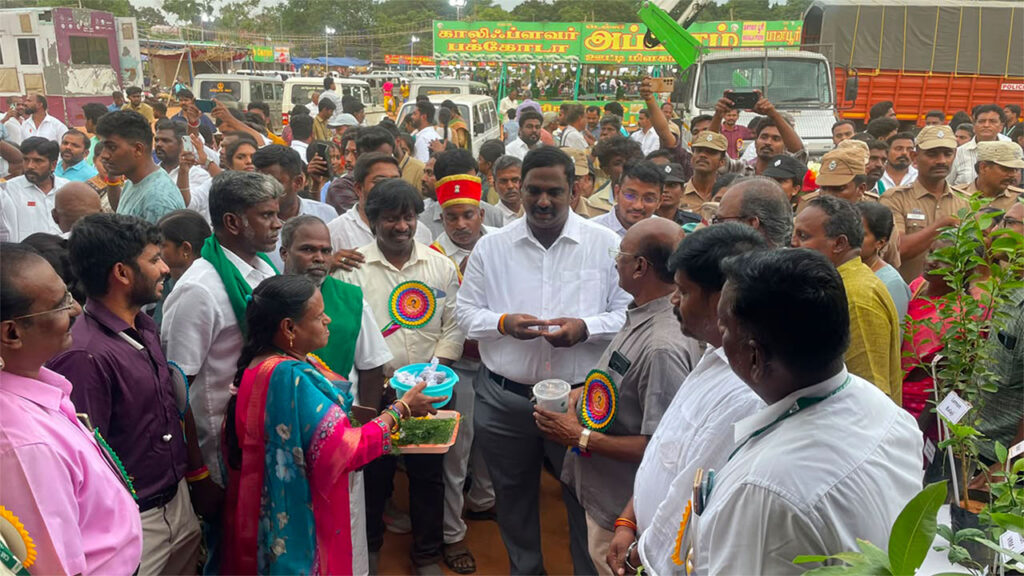
Moringa is one of the most important commercial crops cultivated in Krishnagiri district due to its favourable climatic conditions and high consumer demand. The district has enormous production potential, and many farmers cultivate moringa organically in their fields. However, during peak harvesting seasons, farmers often face severe price fluctuations and market glut, resulting in reduced income and wastage of moringa leaves and pods. Lack of awareness on scientific post-harvest management, preservation technologies, value addition, packaging, and marketing further affects the profitability of moringa cultivation Need for the Intervention: To address these challenges and empower rural women through entrepreneurship development, Krishi Vigyan Kendra (KVK), Krishnagiri conducted an Entrepreneurship Development Programme (EDP) on “Export Oriented Moringa Products” for Self Help Group (SHG) women of Mathur block. The training programme aimed to create sustainable livelihood opportunities for rural women by promoting value addition and export-oriented moringa products. Scope for Export-Oriented Moringa Products: The training programme focused on transforming traditional moringa cultivation into a profitable agribusiness model. SHG women were sensitized on the global demand for moringa products, especially in international markets where moringa-based health foods and nutraceutical products are gaining popularity due to their high nutritional and medicinal value. Export-Oriented Value-Added Moringa Products: During the training programme, the SHG women learned that instead of selling raw moringa produce alone, entrepreneurs can generate higher income through value addition and scientific processing. Various export-oriented moringa by-products with high market demand were demonstrated and explained during the training. Moringa Leaf Powder: Moringa leaf powder is one of the most popular export products. It is widely used as a nutritional supplement in health drinks, capsules, bakery products, smoothies, and herbal formulations due to its rich nutrient and antioxidant content. Moringa Tea: Dried moringa leaves are processed into herbal tea products that are highly preferred by health-conscious consumers across international markets. Moringa Capsules and Tablets: Pharmaceutical and nutraceutical industries utilize moringa powder for preparation of capsules and tablets as immunity boosters and nutritional supplements. Moringa Oil (Ben Oil): Oil extracted from moringa seeds, popularly known as Ben Oil, has high demand in cosmetic, skincare, and pharmaceutical industries because of its moisturizing and antioxidant properties Moringa-Based Food Products: The participants were also trained on preparation of several Ready-to-Eat (RTE) and Ready-to-Use (RTU) moringa food products such as: Instant food mixes using moringa: The women also gained exposure to innovative moringa products including noodles, pasta, energy bars, chocolates, and confectionery products which have increasing demand in both domestic and export markets. Background of the Beneficiary: One of the successful beneficiaries of this intervention is Mrs. Deepalakshmi, aged 39, wife of Mr. Ilavarasan from Mathur village. She studied up to 11th standard and belongs to a socially and economically weaker section. Living in a remote village with limited livelihood opportunities, she struggled to support her family and educate her children. She owned only 5 cents of land where more than 100 organically grown moringa trees were cultivated. Despite having good production, the moringa leaves and pods often fetched very low prices in the market, and a significant quantity went waste during surplus production periods. Participation in Entrepreneurship Development Programme: Realizing the need for additional income generation, Mrs. Deepalakshmi approached KVK, Krishnagiri and attended the Entrepreneurship Development Programme on moringa processing and value addition technologies. Through the seven-day intensive EDP training, she gained technical knowledge and practical skills on scientific processing methods, preservation techniques, hygienic preparation, packaging, branding, and marketing of export-oriented moringa products. Capacity Building and Skill Training: During the training, SHG women were educated on the nutritive importance of moringa and trained in scientific processing techniques including blanching and dehydration of moringa leaves. Hands-on training was provided on the preparation of various value-added products such as moringa leaf pickle, dehydrated moringa leaf powder, moringa cookies, moringa ladoo, instant food mixes using moringa, moringa soup mix, moringa chutney mix, moringa health mix, and extraction of ben oil from moringa seeds. Entrepreneurship and Marketing Support: Apart from product preparation, the participants were also trained on entrepreneurship aspects including branding, packaging, labeling, licensing, FSSAI registration, quality maintenance, marketing strategies, and consumer preference analysis. The programme helped the women understand the importance of hygienic processing and attractive packaging to compete in domestic and export markets. Establishment of Enterprise: With the support and technical guidance of KVK, Mrs. Deepalakshmi successfully established her own moringa-based enterprise under the brand name “Giri Foods” with FSSAI Registration No. 22424103000090. She started producing a variety of Ready-to-Eat (RTE) and Ready-to-Use (RTU) moringa products including moringa soup mix, moringa health mix, moringa chutney mix, moringa leaf powder, moringa rice mix, moringa adai mix, and moringa rasam mix. Economic Impact and Livelihood Improvement: The intervention created a remarkable transformation in her livelihood. Through regular production and marketing of moringa-based food products, she currently earns an income of approximately Rs. 25,000 per month. This additional income significantly improved the economic condition of her family and enabled her to meet household and educational expenses more confidently. Her products gained good consumer acceptance due to their nutritional value, quality, and taste. Women Empowerment through Entrepreneurship: The success of Mrs. Deepalakshmi clearly demonstrates how scientific training, skill development, and institutional support can empower rural women to become successful entrepreneurs. The intervention not only enhanced income generation but also strengthened women’s self-confidence, decision-making ability, and social status within the community. Importance of Institutional and CSR Support: Such entrepreneurship development programmes play a vital role in reducing post-harvest losses, promoting value addition, generating rural employment, and encouraging sustainable agriculture. Supporting women-led enterprises in moringa processing can create long-term livelihood opportunities and strengthen the rural economy. Way Forward: CSR organizations, developmental agencies, and stakeholders can play a major role in scaling up such initiatives by supporting training programmes, processing infrastructure, branding facilities, and market linkages for rural women entrepreneurs. Investment in women-centric agribusiness models not only promotes economic empowerment but also contributes towards inclusive rural development and sustainable livelihood security. In conclusion, The success story of “Giri Foods” stands as an inspiring example of how a small